Monday, October 19, 2020

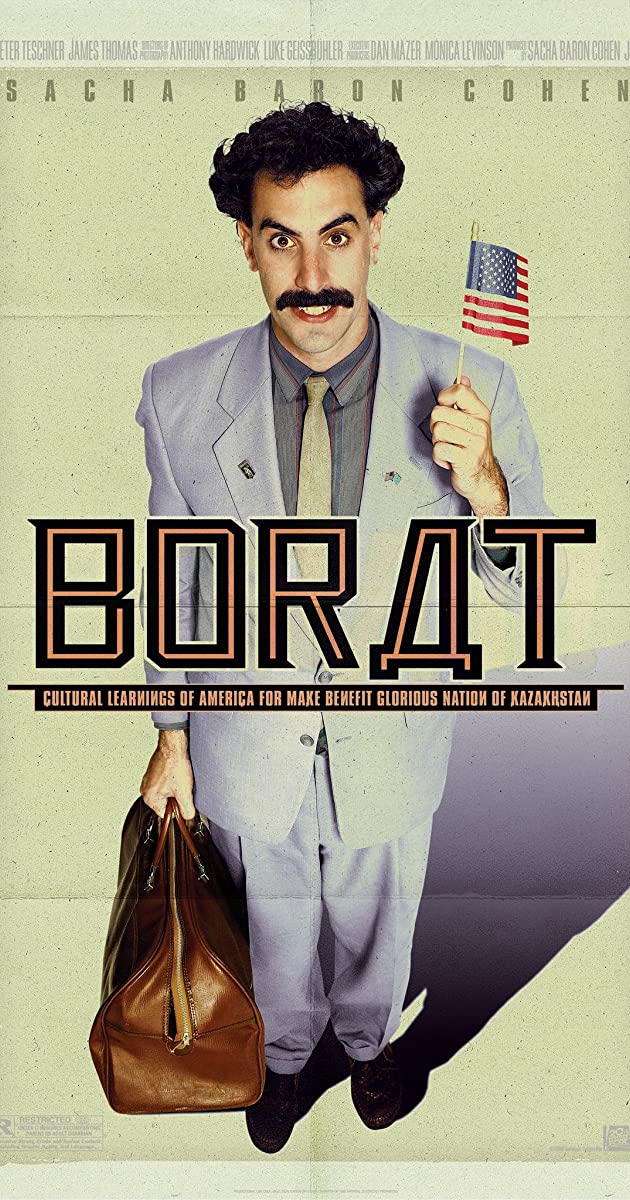
Borat (2006) Film Review: The Mother Of All Mockumentaries!


With the sequel coming on Amazon Prime this Friday, it's time to revisit the film that not only made its star a household name, but introduce a new, albeit controversial, way to make a mockumentary film. Borat Sagdiyev is a Kazakh journalist who is hired to travel across to New York City to make a documentary of the country's culture that can help make Kazakhstan more like them. When Borat learns about the show, "Baywatch" and Pamela Anderson, he decides to travel across the country to California in the hopes of marrying her, unbeknownst to his producer, Azamat. There's not really much of a story per se, but rather a narrative structure to allow Borat to interact with unknowing Americans as they either get weirded out, react casually or harshly to the antics that Borat is always planning. It's without saying that the tone is not meant to be taken seriously at all whatsoever. From the misrepresentation of Kazakhstan, the obliviousness of Borat and Azamat, and the various circumstances that the characters get themselves into, scripted or not. The comedy is very dependant on offensiveness and cringe. It's hilarious for some people, but it can feel low-brow to others. It's not intentionally trying to address problematic people or topics in a clever matter, but instead just have the character of Borat be a bumbling fool and try to offend the various people he comes across. It's almost like a prototype of Cohen's show, "Who Is America?", only with less attempt to expose politically incorrect people by a means of agreeing to their ill-fated logic.

Sacha Baron Cohen as Borat is legendary to say the least. Cohen makes you believe that the character of Borat isn't fictional, but a real oddball with a heart of gold. What really works with making the viewer believe in this character of Cohen's creation is that the sense of cluelessness and obliviousness to American culture and people feels almost logical in a way. Borat also tends to also be a wild card as he doesn't comment or oppose extremist groups or wrong-minded people in order to not break character, mainly when he accepts Christianity from the United Pentecostal. However, he also shows that he can actually pick up on things if he truly wanted to, such as the "not" jokes. Ken Davitian as Azamat is also an actor that should be praised for his contributions in the film. Not only does he act off on Borat's character and partakes in the most extreme scene of the film as he and Borat fight naked in a hotel, but he has this enjoyable personality that makes the viewer both like and hate him for his hostility. The last character to really mention would be Luenell the prostitute, played by the actress of the same name. She really only appears in two scenes, but the chemistry between her and Borat is really sweet. Aside from these three characters, the majority of people filmed and participating are not actors at all. While Pamela Anderson was aware of what was going to happen to her in the movie, the people around her clearly didn't. Although it can be kind of wrong to laugh at people who are essentially being pranked on, there are some genuinely uncalled reactions with the driving instructor being one of the few people to enjoy Borat's presence or the car salesman not questioning Borat's odd questions of what car is best to run over a group of Jews. There's an organic sense to the reactions of people as they observe or be around these fictional characters, even if the viewer starts to question whether or not they were actors to begin with.

Although people might think Cohen directed the seemingly bare-bones mockumentary, it was really Larry Charles who takes the directing credit, who's best known for his work on various TV shows such as "Seinfeld" and "The Tick". Considering his line of work, it's no question as to why Charles took interest in this film. It's hard to really judge directing in a film that's mostly ad-libbed, but what is obviously really noticeable is the efforts to make every scene feel credible with no strings attached. Even scenes that are clearly scripted from the village in Kazakhstan to the various arguments and conversations with Borat and Azamat are directed with such naturalness that it feels genuine, despite the evidence that supports the opposite. The cinematography by Anthony Hardwick and Luke Geissbuhler is a huge factor for making the film work. Much like "Wayne's World", there's a clever mixture of handheld and cinematic approach to the camerawork that is meant to somewhat make the viewer question in what role or character the camera is playing to an extent. Unlike in that film however, the characters or people never actually turn their attention to the camera or address the cameramen or viewer during their visit to America. It takes the approach of a real documentary at times by not having the cameraman be involved in the movie or have any acknowledgement given to them via by a contract. Even though there's clearly a cameraman in the scenes of Borat being "alone", it's how professional the cameraman are to never reveal themselves and to keep this cinematic illusion up for the viewer. The music by Erran Baron Cohen, Sacha's older brother, is really good at making up Kazakh music that is meant for the film and the character of Borat. Regardless if the music is accurate to the region or not, it's actually great folk-inspired music that would make you want to dance very much like Borat himself. Regardless of how much work Charles did directing, he did a good job supervising the project at the very least.

"Borat" is a film that shouldn't be anything more than good, but manages to actually be practically brilliant for its sense of simplicity. Outside of the humour and ethics surrounding the film not being for everybody, the movie is surprisingly well-crafted. From an engaging narrative of Borat exploring American culture while traveling to find Pamela Anderson, the tone and humour being unapologetic over-the-top and funny, Sacha's performance as Borat goes beyond iconic as the actor creates such a loveable character that audiences wish were real, the two side characters of Azamat and Luenell are memorable in their own right, the reactions of the unknowing non-actors are priceless at times, the cinematography by Hardwick and Geissbuhler is low-key fantastic in terms of making the film feel authentic and not having the cameraman be acknowledged whatsoever despite the mockumentary structure, the music by Erran is fun to listen to with the "Kazakh-inspired" folk music offering a really unique score that most comedies wish they can achieve, and Charles's directing ensures the otherwise raunchy circumstances and premise as well as the few scripted sequences feel as realistic as possible, making sure that footage of both scripted and ad-libbed can blend together as one with almost no differences to each other. Even though it's not for everyone, that doesn't excuse that the film is very much an amazing film overall.

Verdict: 9/10. One of the most iconic comedies to date and the prime example on how to make a great mockumentary. I can't wait to watch and review the sequel later this week!

Friday, October 16, 2020

Wayne's World (1992) Film Review: Bill & Ted But With More 4th Wall Breaks And Schwing Jokes!


Mike Myers started off his acting career on SNL with beloved sketches with "Wayne's World" being the most popular. As how some comedy sketches or characters get their own films due to popular demand, Myers got his chance at bringing Wayne and his basement TV show to the big screen. Wayne Campbell and Garth Algar are two air-head friends who run a popular, public access show known as "Wayne's World". A producer from Chicago, Benjamin Oliver, sees potential from the show sponsoring Noah Vanderhoff, the owner of a popular arcade chain. As Benjamin signs a contract with Wayne and Garth, Wayne starts to fall in love with the beautiful Cassandra, the vocalist and bass player of the local band, Crucial Taunt, which Benjamin also seeks attraction with. Even though the plot sounds a bit convoluted at times, the story might as well be non-existent and only serves to have some narrative structure for the movie. It's really the tone and humour that overrides the film along with Wayne and Garth. There are so many jokes, scenarios and random moments that it offers a variety of laughs for any viewer. While the film has a somewhat conventional structure, Wayne or Garth could suddenly break the 4th wall and talk to the camera about what's going on. The humour can be subtle with Wayne moving towards Cassandra in a conventional way or absurd when Wayne and Cassandra partake in a "gratuitous sex scene". Throw in some sex jokes and a hilarious scene revolving Wayne and Garth speaking down against product placement while promoting product placement at the same time, you got yourself a comedy that not only has any restrictions in the humour, it's downright funny.

The characters of Wayne and Garth, played by Myers and Dana Carvey, aren't very unique at first. They almost come across as raunchier clones of Bill & Ted, even though the duo debuted a year earlier than the more family-friendly duo. Even if you manage to remove the extensive humour around them, Wayne and Garth are still very likeable. From Wayne's obsession of rock-and-roll and trying to impress Cassandra with Cantonese, to Garth's awkwardness and overall bizarre mindset, the duo feels both large in life, but somewhat realistic in a way. Tia Carrere as Cassandra mainly just serves as the love interest to Wayne in the "normal meets weird" kind of formula. Yes, you can debate how no one that attractive would give Wayne that easy of a chance to get together, but do you really care? If the viewer is already behind Wayne's back throughout the film, we can get behind the romance between him and Cassandra, which is honestly cute and wholesome in ways. Rob Lowe as Benjamin is simply perfect as the sleazy, successful yet manipulative producer who wants to both take the show and Cassandra off Wayne's hands. He's both charming and despicable and we all root for him to get his comeuppance. As for the side characters, they truly serve the role of background characters, but in a positive way. None of the side characters particularly have much of a personality, instead being more of a specific in-joke or gag, but the actors are clearly having fun hamming themselves up. From Vanderhoff's obliviousness for Wayne and Garth's disapproval, Wayne's mental ex-girlfriend Stacy, Russell's loyalty to Benjamin, Terry's uncomfortable lovingness to the men around him, and even cameos from Alice Cooper and Robert Patrick as the T-1000 all have fun moments and quirks, mainly Cooper's random knowledge of Milwaukee and the Algonquin people. Even though the acting is more on the hammier side, the characters are all fun to watch, with Wayne and Garth of course being the stars of the film.

Penelope Spheeris is probably best known for directing this film as well as revealing the toxic production and drama with Myers behind-the-scenes. Regardless of their fights or clashing viewpoints, Spheeris did a great job in making a movie surrounding these characters. She not only nails the limited production design and management of the modest budget, which is necessary for a movie about two poor guys making a cheap show out of the basement of Wayne's unseen parents, but I like how Spheeris portrays the reception and uniqueness of the "Wayne's World" show in the film. It's sort of like Wayne and Garth are in charge of a popular Youtube channel that they want to avoid giving up to greedy executives. I can totally imagine Myers and Carvey doing a reunion sketch of Wayne's World but updated for the current media landscape. Although we don't see much of the show itself, we get enough detail that Wayne's show is beloved for its unique personality and the energy of Wayne and Garth on-camera. Speaking of cameras, the cinematography by Theo van de Sande is really good, despite how seemingly flat it is. Although the film doesn't sport visually striking shots or sequences and resembles a low-budget TV show with obvious sets, it's how the camera plays the secret role of a character that exists only when the characters want it to exist. A scene can play out as normal, but the viewer only finds out that the camera is a character of that particular scene only when Wayne or Garth addresses it. It's not amazing camerawork per se, but it has great use in the context of the film. The score by J. Peter Robinson is probably the weakest link of the film as I can't recall any original score beats for the life of me, except the "Wayne's World" opening theme. As for the songs featured, the film offers not only "Bohemian Rhapsody" by Queen for the drive to the local doughnut stop and "Dream Weaver" by Gary Wright whenever Wayne gazes at Cassandra, but plenty of good covers by Carrere and Crucial Taunt. I think there might be one original song by the band, but I'm pretty sure they are mostly covers. There isn't much visual effects in the film, but there are mostly simple editing transitions or opticals. They are clearly phoney, but it's meant to be. Honestly, I'm surprised the film costed $20 million to be made, though it just might mainly consist of the various actors and cameos. The direction of Spheeris has a cheap, amateur appeal that works effectively at making the film feel as if Wayne & Garth made the film themselves.

"Wayne's World" is a prime example of a perfect transition from comedy sketch to feature film. Outside of a weak original score and a few familiar story beats, it offers what you'd expect coming from. From the over-the-top tone and ridiculous humour,  Myers and Carvey being the loveable fools of Wayne and Garth, the cast having a total ball being the characters they are, the unique role the cinematography plays in the film thanks to de Sande's handiwork, the soundtrack of licensed songs makes a killer album,  and the direction provided by Spheeris ensured that the film not only has an timeless feel with the portrayal of the fictional show, but puts effort into making the film feel as if the titular character was making the movie himself with the limited budget and resources. It's one of those comedies that feel very unique, mainly thanks to Myer's involvement and creation of the characters. Although the film inspired countless comedies and creators in many ways, it's the wacky original that deserves more recognition than it deserves.

Verdict: 9/10. A creative and zany comedy that is a one of a kind. Watch both this and the almost-as-good sequel for a night of laughs.

Tuesday, October 13, 2020

Mission: Impossible (1996) Film Review: A Mission That You Should Accept For Viewing.


 Starting off as a 60's television series, the "Mission: Impossible" franchise grew into a dominating film franchise as each installment becomes more and more successful than the previous one. The third film onward established the modern action-spy thriller that viewers have come to know from the franchise, while the second film is viewed as the only bad film due to the tone and obsession of action sequences. The first film however remains as not only the stepping stone for the series, but remains to some as the best of the films, even nearly 25 years later. Jim Phelps, the director of the Impossible Mission Force and the only returning character from the TV series, is tasked with retrieving the CIA's NOC list from a rogue agent. Their mission suddenly goes horribly wrong as everyone from the team, apart from the point man, Ethan Hunt, gets killed by mysterious assailants. As the IMF suspects Hunt to betray his group and the mole for the operation working with an arms dealer named Max, Hunt is alone and on the run as he tries to learn who betrayed the group while also attempting to get the NOC list. The story is good with the betrayal storyline as well as how Ethan has to get access of the NOC list and give it to a criminal in order to learn the truth. However, the film is not very connected to the television series or is designed by die-hard fans of it. Not only is there only one returning character, but the reveal that Phelps is in fact the villain can piss off certain fans akin to a similar twist done in the 2019 "Charlie's Angels". The pacing and tone is also a departure of itself, mainly to the rest of the movies. Compared to the modern action blockbusters that use a lot of tech and stunts, the first film in the franchise goes more of a spy thriller akin to early James Bond. This can disappoint some fans of the modern films or action in general as there's a lack of action throughout. Regardless, I like the direction of it being an amped-up classic spy adventure that doesn't relay on gunfights or fistfights. However, the pacing is a bit of an issue as the story moves slowly with periods of exposition being explained at times.

Tom Cruise as Ethan Hunt is the role that cemented his career for good reason. Not only is he allowed to pull off stunts while throwing his charming charisma and smile to the audience, but Ethan is depicted as a very capable and intelligent agent. He manages to be one step ahead of the opponent due to his ability to analyze his surroundings and claims made from others. However, he's not a perfect hero as his missions and plans are extremely reliant on his co-workers and friends as well as the trust he has for them. He can't and doesn't want to be a one-man army, but he's able to outsmart everyone around him if it comes down to it. Jon Voight as Phelps is good as always, but his performance isn't going to be a memorable one in his career mainly due to the lack of screentime the viewer has with him. The twist surrounding him being the villain is only effective for those who are aware of the TV series and his personality doesn't fool you into not throwing away any suspicion from him. While the character works fine as is in the movie, he's probably one of the most forgettable villains in the franchise. Emmanuelle Beart as Claire, the much younger wife of Phelps, is good as the femme fatale and love interest of Ethan. What I like about the relationship between the two is that much like Ethan, the viewer isn't aware if she's good or bad. Ethan wants to truly trust her and keep his guard down, but after the events from the beginning of the film, he knows that he shouldn't trust anyone, even the woman he holds feelings towards. Ving Rhames, much like Cruise, makes his career-defining role as Luther, the disavowed IMF agent/hacker who remains to be the only ally Ethan can truly relay on for the entire franchise. Rhames just has this great voice and personality to the character that, while not memorable in the first film due to his late debut in the second half, marks him as one of the best teammates in film. The side characters are also pretty strong from Jean Reno's Kruger, a disavowed IMF pilot that Ethan hires, Vanessa Redgrave as Max, the wealthy arms dealer that Ethan is offering to sell the NOC list to, and Henry Czerny as Kittridge, the IMF director who is going after Hunt due to his suspicion that Ethan is the mole of the operation and the one who killed his team. The cast is pretty good for the most part, but Ethan's team in the beginning of the film is another story. Despite the recognizable names attached to them, I don't even want to bother attempting to describe the characters, let alone the actors, as they are only used to get killed off in the story. Perhaps if the team consisted of members of the television series, it would be more effective for shocking the viewer, but considering that the actors of said series hated the way Phelps was treated, they probably wouldn't go through with the idea. Regardless, the cast of characters are pretty enjoyable and acted well, but it's Cruise as Ethan who takes the stage.

Brian De Palma, the acclaimed director, takes charge in the first film of the franchise. Although there are stories of how De Palma and Cruise collide on set in terms of the film's vision, he really did a good job in not only directing the film, but giving the first film in the franchise a unique voice and look.  If you watch one of De Palma's films, such as "Carrie" and "Scarface", you know that De Palma loves lavish set design and camera movements that goes in an avant-garde direction. "Mission: Impossible" follows his direction, creating a unique experience for the film that the sequels can't replicate. The location and set designs of Prague allows to incorporate these exotic interiors, while the CIA headquarters has an ultra-modern aesthetic to it. The film perfectly blends the old-school spy films and series of the 60's while having a twist of modernism not only by the sets and locations, but by the tech and gadgets used throughout. The gadgets are simplified and consistent with the spy glasses, smart watches, and explosive gum. The face masks are the highlight though as they were in fact made from scratch by talented make-up artists. The 90's technology might seem dated with the old cell phones, internet and abundance of Apple laptops, but it adds to the idea of old vs. new. In fact, if the 90's technology were removed, the film could've been set in the 60's due to De Palma's unique direction. The cinematography by Stephan H. Burum adds that distinct De Palma feel with the tracking shots, Dutch angles, establishing and extreme close-up shots of faces. The score by Danny Elfman is great as always with the iconic main theme burning into your memory along with some decent spy-esque themes. Despite the lack of action, the film makes up for it with two excellent sequences. The mission in the CIA headquarters is perhaps one of the most memorable and a top contender for the best moment in the franchise. The suspense of Ethan trying to secure the NOC list as Kruger is struggling to hold on to the rope to avoid Ethan being detected is not only one of the most iconic scenes in the genre, but is enhanced by the lack of music during the scene in order to maximize the amount of suspense. The climax with the bullet train and helicopter as Ethan tries to take down Phelps while Luther attempts to prolong the transfer and download of the NOC list to Max is really good. The CGI and green-screen holds up pretty well, Cruise is doing stunts against high winds on a model train, and the payoff of the helicopter exploding and Phelps rather gruesome death is just a great payoff. Despite De Palma's frustration with the project, I believe that he still made a great movie and one of the best in his career.

"Mission: Impossible" is the starting point to a great franchise and a memorable film stand-alone. From a good story, the heavy focus on modernizing the classic spy formula without the use of action, Cruise as Hunt makes a career-defining role, the side characters are well acted and memorable, Burum's cinematography is great, Elfman's score is as energizing as ever, the two standout spy sequences are both very entertaining and iconic in their own right, and De Palma's directing brings out his usual flair of lavish set design and creative production design to perfectly blend classic and modern spy motifs into one another with locations and technology being pivotal for the identity of the film. However, the film itself isn't as smooth as a perfectly executed mission. The pacing of the film can be slow at times with various scenes of exposition, the lack of action can turn fans of the modern films off a bit, the portrayal of Phelps is underwhelming as he doesn't have much time in the film to make much of an impact as the villain and also creates an unsatisfying portrayal compared to the television series, and Ethan's team in the beginning don't feel much like characters but rather as plot devices pushing Ethan forward in the story. It has some flaws that the newer films might not have, but the first film is very much a unique film in its own right and is important for sparking a blockbuster franchise that no one would have expected to see continue for nearly 25 years!

Verdict: 7.5/10. Really solid film that has aged pretty well for its unique identity. Check this out if you're a devoted fan to the franchise or if you love the classic spy films or motifs.

Friday, October 9, 2020

Alien Apocalypse (2005) Film Review: Can't Spell B-Movie Without Bruce Campbell!

When you think of the term, cult movie or "B-movie", a handful of names might come into your mind. Perhaps Ed Wood, Roger Corman, or maybe no one at all. For me though, when I think of a person relating to cult films, Bruce Campbell always comes into my head and this film is no exception. 40 years after a probe mission in space, a crew of astronauts return to Earth to discover that the planet has been taken over by termite-like aliens who have enslaved the human race and use them to harvest wood. When one of the astronauts, Dr. Ivan Hood manages to escape his newfound prison, he must locate the former president of the U.S.A as rumours keep spreading that he has been training an army for the past couple decades in hopes to rise up against the aliens and to save his girlfriend who has also been captured. The story is ripping off films such as "Planet of the Apes" and "Spartacus", but it manages to solidify the world that it has created that it honestly manages to have its own identity, despite its crystal clear inspirations.  Besides, with a title like "Alien Apocalypse", it's quite clear that you are not meant to really take the story seriously. The pacing for the less than 90 minute runtime though is much slower than I expected. While the story is constantly moving, there are plenty of scenes where Ivan is just learning about the world, the people or talking about himself to others. It's not crazy action or antics the entire time, which I didn't disappoint me. The tone reflects the goofy title as the film itself can be so amateur that it's hard to not laugh, even in some serious scenes. However, there was a scene where a women gets raped that's taken so seriously only for said rapist to get killed off with a hilarious one-liner. The scene didn't need to be there as it not only added anything to the story, but it's such a dark scene that comes out of nowhere in such a goofy movie. 

Bruce Campbell as Ivan is as basic of a Bruce Campbell role as you can get, which means that it's amazing. I was worried at first since he didn't seem to be entertaining in the first act when he and his girlfriend are captured into the sawmill camp, but as soon as he manages to escape, Campbell gets really comfortable in the role and plays it as straight and charismatic as he can. I also genuinely love how Ivan is integrated as the leader of the resistance due to his occupation as a doctor, which the world lacks of. Although it can get repetitive, I do like seeing Ivan heal the people around him and have them join into his own little army. It also helps that Campbell is really the only legitimate talent the film has. Renee O'Connor plays Lt. Kelly Lanaman, the love interest of Hood and the only other surviving astronaut in the group. There's really not much to say about Kelly, considering that she vanishes during the second act. For having a military rank though, she doesn't really try to fight much at all and just ends up being a damsel in distress that Ivan has to save. The last character with a somewhat recognizable actor attached to is Peter Jason as President Demsky, the former president of the U.S.A and a man who cowardly hides with other former government officials in the mountains. Jason is probably the second best actor in the movie, but that's just because Jason is the only other competent actor in the film. As for the side characters, there's the two astronauts who die in the first ten minutes, the human bounty hunters who acts as enforcers for the aliens, the various men who join Ivan either due to their desire of freedom or because Ivan healed them of their issues, and the one attractive women in the group who is the subject of rape in the aforementioned scene and a product of desire for the various men that isn't Ivan. All of the side characters, aside from the astronauts, are Bulgarian and their acting is clearly comprised of ADR. To be fair, the dubbing did fool me for a little while as the dialogue did fit with the syncing of the mouths, but it just adds on to the "B-movie" charm that the film is going for. I will discuss the aliens themselves when I talk about the effects, but aside of Campbell and Jason, the acting and characters are either borderline generic or hilariously dubbed to hell.

Josh Becker, a friend of Campbell, directs the made-to-TV film and considering his extended background in TV shows, it's about as good as you can get... which is not saying much at all. The movie takes place in Oregon, which is really just Bulgaria. There are only two environments in the movie. The desert-looking valley that is shown in two scenes and the forest. The forest in particular doesn't makes sense as the aliens are supposed to be harvesting wood for the past 20 years and yet there's still a nature park's worth of it in the entire film. The sets regarding the sawmill, underground prison, "Freedom Town", and the President's mountain bunker are actually well designed and modelled for a film that doesn't care about how lazy it can be. The cinematography by David Worth is worth very little. The shots are standard at best, flat at worst.  There are a few long-takes though that are decent. The score by Joseph LoDuca isn't memorable per se, but for this type of movie, it's actually pretty good as it contains a variety of themes that fit the genre and feel. What's not good is the audio mixing. Not only is the music louder than the dialogue, but anyone who isn't Campbell sound like they spoke out of a soda can. If you thought "Tenet" has poor audio-mixing, you haven't heard this movie at all to judge! The editing by Shawn Paper is both charmingly good and bad. For the commercial break moments, it edits out at some decent moments. However, you can tell that a lot of scenes got left out in the editing room. How can I know this? Because ten or more people join Ivan offscreen during his journey to the president! Like, if the movie were any longer, Ivan would have gotten a country's worth of an army before the climax! The aliens themselves are mainly comprised of CGI that look like top-end Nintendo 64 graphics. Their designs are basically giant green termites that have a secondary mouth they use to bite people's heads off. The only thing I like about the aliens is that they are so incompetent during the action scenes. All they do is stiffly look around as they get pelted by arrows. Speaking of the action, the climax is laughably done due to how repetitive and bizarre it can be. The resistance apparently only has access to bow and arrows and swords, despite the use of rifles throughout the entire film prior. The aliens only manage to kill people by blowing up wood piles to squash whoever is unfortunate to be there. The amount of aliens in the area is never explained as by the end, an entire army shows up despite only being one tank. The one tank the aliens use decimates the resistance akin to that one moment in "Avengers: Endgame" where the only threat to the heroes was the one vehicle that the aliens had in their disposal. Ivan uses a sword to slash offscreen aliens to insert shots where swords go into prosthetic bodies, and the issues pile on and on. To be honest though, the issues found are more enjoyable and perhaps the better option Becker can go with. In general, the film isn't well made, but it's just so fun watching all of these fumbles after another.

"Alien Apocalypse" is a what you see, what you get movie. If you're seeking an entertaining "B-movie", you've found what you're looking for. There are issues galore to be found from an unneeded rape scene, large cast of side characters that are forgettable and dubbed to hell, the two environmental backdrops don't match at all in the context of the film, Worth's cinematography is for the most part amateur, the audio mixing is horrendous, Paper's editing has the worst continuity error of all time by the abundance of allies Ivan suddenly has in his crusade, the aliens are generic insect-based and look like they came from a video game, and the climax is stuffed with so many issues that it speaks for the film by itself. However, not only was this expected, but I found a lot of enjoyment and even some qualities to the film. The story and pacing is solid despite the whole rip-off nature to it, the tone is for the most part unapologetically silly, Campbell as Ivan is not only fun to watch, but also serves as a pretty solid character in his resume, the set design for the various locations and interiors are actually really good given the cheap production and lazy mentality, the score by LoDuca is surprisingly decent for the film it's attached to, and the directing and filmmaking management by Becker is so poorly overlooked that you can't help but love seeing the countless mistakes. It's a so bad, it's good type of movie that actually manages to outshine big-budget movies not only out of entertainment, but even by quality at times. I'm not going to lie, I would rather watch this over a movie like "Don't Breathe" or "The Predator" any day of the week.

Verdict: 5.5/10. A broken mess quality-wise. An enjoyable soon-to-be cult classic entertainment-wise.


Tuesday, October 6, 2020

Shin Godzilla (2016) Film Review: A Different, Yet Extremely Effective Approach To A Godzilla Movie


Godzilla has been around for almost 70 years. During the 2010's, we have had two films made by Warner Bros that tie into a franchise that will lead into "Kong vs Godzilla". However, neither of the two films stand as being really good. You can get some entertainment out of them for sure and they do have a lot of production value out of them, but not only are there some critical issues, but the films never fully feel like a "Godzilla" movie. In fact, the only company that seems to know how to make a real "Godzilla" movie would be Toho themselves. "Shin Godzilla" serves as a reboot to the original series and takes on the form of a remake of the original 1954 classic. It revolves around the Japanese government encountering and dealing with this new threat formed by an evolving specimen that acts as an organic nuclear reactor. As the newly-named Godzilla starts to wreak havoc on Tokyo, government heads from both Japan and the U.S attempt to exterminate the monster, but to no avail, eventually leading for both countries to offer one last contingency plan, with Japan opting to freeze the creature, while the U.S wants to hit it and the city with a nuclear bomb. This is classic Godzilla at its finest, which means that you shouldn't expect any of the beloved monsters aside from the titular beast to show up. Not only that, but the film heavily focuses on the government response to this threat, meaning that majority of the film is spent on a somewhat realistic depiction of the government trying to deal with Godzilla, albeit with some bits of humour here and there. The structure of the film can make or break it for plenty of people, as some viewers just want to see Godzilla destroy things most of the time and not care for the human characters. Personally, I love this change of formula. While I would mainly prefer seeing more of Godzilla, it's the serious tone and handling of the characters that really work for me. The film almost feels real in a way, despite having a silly-looking monster in the forefront.

The cast of the human characters in these movies are generally known to be rather weak and forgettable, which doesn't help that said movies put a lot of focus on these characters. With the case of "Shin Godzilla" though, this is probably the best cast I've seen in a Godzilla movie and that's mainly due to how the characters don't act like characters, but like real people. I'm not going to bother talking about every individual character as the majority of them tend to not have a distinct personality, but rather a specific role in the government. The only two characters worth noting are Rando Yaguchi, the Deputy Chief Cabinet Secretary, and Kayoco Patterson, a Japanese-American representative for her home country. These two are technically the main characters as they do have some sense of character and personality, with Kayoco having the most development and charisma in her performance. Aside from them, the cast all do a fantastic job with the roles given. While they don't have enough time to develop unique personalities perse, they do give the viewer enough time to show that they are human. From the prime ministers, the military heads, and the research heads, the actors and actresses show a sense of both vulnerability and humanity while having a touch of humility, with the acting Prime Minister being a prime example. While the new "Godzilla" films might have more memorable characters, albeit in a limited quantity, "Shin Godzilla" thrives in the characters not being characters, but rather portrayals of real people working in the government, which is much more effective than having one or two likeable characters and killing them off.

The directors, Hideaki Anno and Shinji Higuchi, are primarly known for their works on beloved franchises in the anime community, namely "Neon Genesis Evangelion" and "Attack on Titan". Although it seems strange to have men suited in anime to direct a live-action film of an entirely different property, they both manage to have it work really well. The strongest aspect of the directing would be the look of the film. It's extremely cleaned-up and polished, but not in a professional, Hollywood way. More like filming off a nice handheld camera or phone way. As the story and characters reflect a more grounded approach to the series, the look of the film should be realistic in a sense and almost like news coverage or private recordings. Tokyo has never been so grand or layered out than ever before. The directors make sure that not only are we aware of the size of the city, but how crucial the damage, radiation and density of the city is towards the citizens and the country. The make the movie feel very much like a disaster movie, as the original film intended to be. This is supported by Kosuke Yameda's cinematography, which adds some nice personality to the otherwise standard shots used throughout the film. I love the unique shots that either put you in the perspective of a citizen as you see this giant monster stomp around, the tracking shots as we follow people as they move around as if we are in a hurry, or even the fun moments that has the camera set on an office chair as workers assemble a meeting room. Yameda's cinematography really adds much needed energy, and it's helped by the editing which, while choppy at times, gives the movie a sense of flair and a bit of cheesy comedy. The score by Shiro Saguisa is really good and probably the best of the soundtracks offered by these new "Godzilla" films. Of course, you got the classic renditions of the famous themes of the franchise, but you also got unique beats and uses of various instruments and styles. I never expect to hear bongos during the attempted attack on Godzilla, but I manage to really like it. The use of music at times feels somewhat out of place, but it generally works at giving the film some sort of levity and fun for a very serious tone. The visual effects are designed to be somewhat campy in terms of quality and design. Some of the action scenes are pretty fun to watch mainly because of how funny the effects are when it comes to certain aspects, such as the train bombs and destruction. For a movie with a modest budget of fifteen million, it's acceptable for the most part. What might not be acceptable though is the design of Godzilla in general. They went with a more silly, almost derpy-looking design for the iconic monster, paying homage to the original films that use the rubber suits. However, the movie doesn't use rubber suits at all, just standard CGI. The first time you see Godzilla, he looks absolutely ridiculous as the first evolutionary state. But even when he evolves to its final form, the eyes look a bit silly for such a cool design. When they cut to Godzilla far away in the city, he looks oddly adorable in a funny way. For a movie that takes its tone and characters really serious, the design seems like a baffling decision. If they went with the superior design in the newer films, it would have been less distracting.

"Shin Godzilla" might be the best modern Godzilla film to date, if you're willing to accept some narrative and stylistic decisions. From a great depiction of how the Japanese government will respond if a creature like Godzilla existed, the tone taking itself very seriously while leaving some way for a bit of levity and humour, the acting is fantastic for filling in these government roles, Yameda's cinematography adds a lot of character and energy in a grounded-feeling movie, Saguisa's score offering both familar and charmingly unique beats to the series, the visual effects and action are well made for the limited budget and premise as well as offering some charm, and Anno and Higuchi's directing do a perfect job in making the film feel grounded in realism with the look of the film and the extensive use of the city of Tokyo. However, it's easy to see why not everyone is keen on the film. There's no extensive scenes of action or additional monsters that Godzilla fight, the pacing can be pretty meddling due to the political approach, the characters aren't written to be distinct or attachable, and the design of Godzilla himself isn't really cool, but silly. Regardless, if you don't mind these sacrifices, you are rewarded with a surprisingly great film that's unlike the usual Godzilla flair. 

Verdict: 8/10. Great, but not designed for everyone. At the very least, it's far better than the newer Godzilla films when it comes to quality.

Friday, October 2, 2020

Captain Underpants: The First Epic Movie (2017) Film Review: Takes Flight Like An Ostrich!


If there's one series that every kid growing up has heard of at some point in their lives, it would be Dav Pilkey's "Captain Underpants". Despite the immaturity and potty-centric humour, the series is beloved for its loveable characters, clever humour, charming stories, and how Pilkey is aware how his fans get older with time, which allows his older books to be more complex, funnier and even adult at times. I remember as a kid that a move based on the series was in development and I couldn't wait to see it. Well, it came out by the time I was a senior in high school, but I still took interest in such a nostalgic property and although it's not one of Dreamwork's biggest hits in recent years, it's still a very memorable one. George and Harold are a couple of fourth-graders who are best pals. They mainly get along by their love for pranks and creating comic-books, especially those that star the made-up Captain Underpants. After their latest and biggest prank, Principal Krupp has had enough and is forcibly switching their classrooms in the hopes to destroy their friendship. By a bizarre circumstance involving a hypto-ring, the boys manage to hypnotize the mean principal and make him believe that he is Captain Underpants. This proves to be a big mistake as not only is the hero extremely dumb and is prone to trouble, but a mad scientist has just moved into town and hopes to erase laughter from the world, to which George, Harold, and Underpants must stop. The story takes a lot of elements from the first four books. From the origin of Captain Underpants in book one, the science competition, Turbo Toilet and school nerd/secondary antagonist Melvin in book two, Underpants getting his superpowers in book three, to Professor Poopypants being the main villain from book four, the movie takes all of the most noteworthy elements from these first few books and combines them into a familiar, but somewhat original story that doesn't require any of said books to be read. The film is very much light-hearted and any stakes or drama inserted is not really meant to be extremely gripping, but effective in its own silly and charming way. Not only that, but the humour is ripped straight out of the source material. From the fourth-wall breaking, the adult jokes, the absurd situations, and of course, the toilet humour, is all represented. This can be a bit of a problem though as some of the jokes, mainly the toilet humour, can be pretty cringe. However, not only is the film aware of this and does try to offer a more grown-up joke to balance it out, but the more intellectual or dark humour sprinkled throughout is really good. Any age group can find at least five jokes that worked for them in my opinion and it's thanks to the witty script that almost feels as if Pilkey himself wrote.

The voice acting cast is one of the most weirdest, but most effective I have ever seen or heard in an animated film. Starting with Mr. Krupp/Captain Underpants, Ed Helms is just fantastic in his vocal performance. Krupp is the stern, mean, somewhat awkward principal, while Underpants is the complete opposite with an optimistic point of view, dimwitted, goofy sense of justice. Helms's voice suits both personalities and it's his voice that I imagined how the character would sound. Nick Kroll as Professor Poopypants is also an inspired choice as the European mad scientist who, despite his brilliant mind, can't learn to ever laugh at himself. At times, it does sound like the typical performance Kroll is always pointed out for in his animated movies, but it's definitely my favourite vocal performance of his. Kristen Schaal as Edith, the school lunch lady who is an original character for the movie and Mr. Krupp's love interest is also a warm presence to grace the film. Despite all of this praise to these voice actors, it's the actors playing the kid characters that are the most noteworthy. If someone would've told me that grown men such as Kevin Hart, Thomas Middleditch, and Jordan Peele were voicing George, Harold, and Melvin, I wouldn't have believed them. But, wow, these guys are just killing it as these characters. They don't sound like little kids per se, but they got the personality of them so perfectly. Personally, I would have had real kids voice-act as kid characters, but the fact that the filmmakers manage to not only get these big actors, but for them to also put their effort in having a high pitch to sound like these characters is just a sheer level of dedication for both the actors and the filmmakers. Aside from them, there's not much to note for the side characters as the other school staff, teachers, and students are not really given much screen-time or dialogue for that matter. It's the main cast of characters and actors that are the stars of their own movie, who not only does each one knock it out of the park, but Hart, Middleditch and Peele need to pat themselves on the back for their performances.

The animation was provided by Mikros Images and they are the king when it comes to making these 2.5D animated films. Not only does the animation carry the classic character designs and art style from the books and presents them in pleasant-looking three dimensions, but the animation itself is just vibrant and colourful. For a very modest budget in the animated industry, the animators manage to put so much detail in the materials of the hair, clothing, and various objects. Although the character designs have a simplified approach with the beady black eyes and a lot of smoothness on the skin, it's meant to be like that not only for the budget, but to homage the books. What's so endearing of the animation though is the range of variety and the clever use of said variety in order to keep a low budget. Not only do you have the CG animation, but you also have hand-drawn sequences where the homemade comics come to life, a brief scene with animated paper cutouts, and even a scene with sock puppets! However, one can tell that this film has a limited budget due to the lack of interesting or engaging backgrounds, which gives the picture that the world the animators created is very limited in scope and feel. While this might not be the best animation that Dreamworks is known for, it's clearly one of the most inventive and unique to say the least. The music by Theodore Shapiro is decent for a typical family film, though it's really geared towards the younger demographic, especially for the songs the boys will sing or participate in from time to time. Still, it's kind of charming in its own way and even the original composing is not that bad. The highlight in the musical department though is "Weird Al" Yankovic singing the theme song for Captain Underpants. Not only is it again paying homage to the books where Yankovic's music is always mentioned, but it's a nice song to match the movie. Director David Soren might have started his directorial work with a trip with "Turbo", but he got himself together and even exceeded everyone's expectations with his efforts on bringing the beloved characters to animated life. Here's hoping he can direct another animated project soon!

"Captain Underpants: The First Epic Movie" is probably my favourite Dreamworks film of the 2010's. From the story taking a lot of elements from the source material while being somewhat fresh, the tone being unapologetically over-the-top and silly, the humour having a lot of range of jokes targeted towards kids and adults, the characters being very likeable and expressive thanks to the talented voice cast that were brought on, the animation being both really polished while keeping in nature to Pilkey's character designs, and the score and songs by Shapiro and Yankovic are not only decent, but very appropriate for the source material. Despite all of this, I'm quite aware that it's not for everyone and it's not going to rank anywhere near the best the studio has put out. The direction of the tone is not going to be breaking your heart or give you a emotional journey unlike other animated films, the film's obsession of toilet humour might be too much for certain people, and the animation might come across as cheap at certain areas, mainly when it comes to the backgrounds and world-building. Then again, it's clearly meant to skip those points, especially for a film based on this specific franchise. If you were ever a fan or even aware of the books when you were a kid, you might be pleasantly surprised by how entertaining and well-put together the film is. Of all of the films Dreamworks is scrambling to make sequels for, I'm surprised they never considered to make one for this.

Verdict: 8/10. A great family film that Dreamworks should be proud of owning. If you just want to watch something fun and goofy or got kids around, this is a must-see!


Monday, September 28, 2020

Braveheart (1995) Film Review: A Historically Inaccurate Epic That Still Stands The Test Of Time.


Historical/Biopic films are a hard genre to do justice. Although it seems rather easy to just copy every event or moment that a historical figure has been recorded to be a part of, there's the issue that filmmakers need to ensure that audiences are engrossed in the film itself, which would result in fictional aspects in order to have the film be somewhat conventional in otherwise unconventional stories. Such was the case for Mel Gibson's take on the First War of Scottish Independence. In 1297, King Edward "Longshanks" has already conquered Scotland and has allowed his nobleman to take over land and earn special privileges, despite the misfortune of the Scottish people. When William Wallace marries his childhood friend, she is suddenly executed for fighting off English rapists. Wallace demands revenge as he and his plan overthrow the local English occupants, starting a war between the English and Scottish people as the latter refuse to stand down to their oppressors. I think it's common knowledge that although the film covers the basic story of Wallace and the war, there are plenty of inaccuracies scattered throughout that make the film look really questionable, especially by today's standard. From the occupation of Scotland, the portrayal of various characters, to the dramatization of the war itself, the historical inaccuracies pile on and on. With that said though, I actually don't mind the changes from history that much. Keep in mind that not only is Gibson starring and directing a medieval epic, but he not only has to do the story of Wallace and the war some sense of justice, but to also make a coherent and gripping story for a variety of audiences. Heck, if one watches the commentary, Gibson himself admits that he knew of the inaccuracies, but had to make choices for the film to be more compelling for a general audience. Regardless of the inaccurate take on history, the story still works as a medieval war flick that has a bit of comedic and romantic aspects to draw in plenty of audiences and ensure an gripping, entertaining film, you just have to accept that it's not a really good representation of what happened in history.

Mel Gibson as William Wallace at first seems like a really bad choice on people. Not only is the director the star of his own movie a really pretentious act, but the fact that he's an Australian trying to play a historical Scottish figure seems like it should derail the entire film. However, when you watch the movie, you would honestly be surprised by how good Gibson is at playing Wallace. His Scottish accent is pretty decent, he mixes his established charisma to this leader figure that makes him more likeable, he has the slower dramatic moments to flex his acting skills, and he simply brings this badass warrior that only Gibson can really pull off. Sophia Marceau as Princess Isabella of France acts well, but her character is only thrown to have another love interest for Wallace, considering the character being unrelated to Wallace in real life. Patrick McGoohan as King Longshanks does a great job as the tyrannical ruler of England who wants the Scottish people to be put to place, which he believes will occur once Wallace is dead. From then on, there are too many side characters to list, but I will name a few that I find pretty memorable. There's Angus Macfadyen's Robert the Bruce, who is conflicted whether or not he should join Wallace or follow Longshanks, Catherine McCormack's Murron, Wallace's newlywed wife and childhood friend who is killed during the first act of the film, Brenden Gleeson's Hamish, Wallace's longtime friend and formidable warrior in the army, James Cosmo's Campbell, Hamish's father who always has the spirit to fight no matter how many injuries he sustains, and Peter Hanly's Prince Edward, the son and successor to Longshanks who fears his father's wrath and is secretly a homosexual. All of the actors do a great job and the characters, major and minor, all manage to have a sense of humanity and personality, which is mainly by how great the cast is. However, even though every character gets their moment to shine, it's Gibson's leading role as Wallace that is the highlight, mainly by how he manages to excel expectations of his performance in general.

Gibson's second film directing proved to pay off as this film got him the Oscar for Best Director during that year. Regardless whether or not you like Gibson as an actor, no one can deny that he can't direct a movie. It's quite clear that his experiences in Hollywood managed to grant him this gift of directing that's unlike any other. Gibson is always known to have a sense of scale and grandeur in his films and "Braveheart" is clearly no exception. The use of backdrop locations in Ireland and Scotland for one really lets the viewer transport to that country. On top of that, the production design and costumes are great in capturing the 13th-century attire. Of course, there are some inaccuracies here and there, but I love the simplistic and raggedy costume design. There are no shiny knights or a variety of fancy uniforms, the costumes are baggy, dirty, and appropriate for the time period of the early medieval setting. The Oscar-winning cinematography by John Toll is well-deserved to say the least. Not does Toll offer excellent shots of the expanding landscape, but also some intense close-ups and carnage during the action sequences, as well as some nice angles and set-ups to showcase the sets and locations. Toll was clearly Gibson's best choice in visualizing his vision and I'm glad that he's still working to this day. The late James Horner also offers a really good score to boot, showing that everyone in the project is giving it their all. Of course there's all of the familiar Scottish beats such as the bagpipes and flutes, but offers some nice love themes and the action themes. It's nowhere near Horner's best works, but it's still very adequate. Speaking of the action, it's spectacular to say the least. Although compared to today's standards, it's not extremely bloody, but it serves as the standard for crafting well-made, extended sequences of exciting violence that series such as "Game of Thrones" take influence from. The action is always intense, you always question if the characters can pull through, and the editing by Steven Rosenblum is nicely done to show just enough of the on-screen carnage before things get too grotesque. The scene of Wallace's execution for example is fantastically put together to feel the agony and torture Wallace is going through, but Gibson and Rosenblum knew to never show any actual gore as they know Gibson's acting and audio effects are just enough to make you squirm in your seat. Inaccuracies and personality, Gibson knows how to make a fantastic film.

"Braveheart" is what you can call a flawed masterpiece. Sure, the film has a variety of historical inaccuracies that doesn't do the story of Wallace and the Scottish War of Independence full justice and the romance between Wallace and Isabella is very forced into the narrative, but aside of that, one can't deny how excellent of a film this is. From the well-balanced tone and engaging, if inaccurate, story, Gibson's acting as Wallace, the entire cast in general doing a great job giving their characters a sense of humanity and realism, the production and costume design transporting the viewer back to the 13th century, Toll's cinematography is just great, Horner's score is really good, the action sequences are extremely entertaining and well-edited by Rosenblum, and Gibson's directing offers the grand scale and scope that was necessary to accomplish the stakes and environment of the war. Even 25 years later, it's remarkable how the film is still amazing to watch and the quality of the filmmaking and acting is still preserved, despite a notorious inaccurate story. While it might not be his best film as a whole, Gibson still demonstrated that he not only has acting talent, but also the talent of a brilliant director.

Verdict: 9/10. An astonishing film that's only hampered by the historical inaccuracies. If you love medieval epics or blood-filled battles though, it's definitely one to check out!